I’m doing my favorite thing for my birthday. I’m hosting one of my favorite people on my blog. Karina Fabian is a wonderful writer I have been honored to call a friend for several years now. She has several books available through Amazon, her site Fabianspace, and all over the internet. Seriously, Google her.
Her latest release from Full Quiver Press, Discovery, is about nuns on an exploratory mission to investigate a crashed space ship on an asteroid. I asked Karina about how science fiction and our current technology were related. It got her started on why she loves writing science fiction. Check out her response below. Then go over to her site and check out all of her work.

Why I Love Writing Science Fiction
One of the best things about being a writer of science fiction and fantasy is that sometimes, science fiction comes true. Communicators and replicators of Star Trek are cell phones and three-D printers of today, for example, but there are scores of different technologies that were imagined or popularized by science fiction writers long before they became practical technologies.
There are three reasons for this. The first is that scientists are often science fiction writers. Isaac Asimov, who wrote Foundations, I Robot and other famous science fiction stories, was a biochemist. More recently, we have Michael Crichton and Travis Taylor, both science fiction writers with science degrees.
Second, science fiction authors, even when not scientists themselves, often study science and think about the applications. For my own stories, like Discovery, I had to study VASIMR drives and spacesuit technology. I then pushed that technology about 150 years into the future, imagining what we could do if untried research came to fruition and widespread use. Other writers (and me, in other stories) push the envelope further, taking wild theories and imagining their applications and consequences, and when no theory is available, creating one in a “What if”?
The final reason – and my favorite – is that scientists are inspired by science fiction. It’s no surprise that the communicator of the 1960s Star Trek became the flip phone of the 80s. The inventor was directly inspired by the design. Many other Star Trek technologies, even the outlandish idea of warp drive, are being studied by scientists today. In print, we can point to Jules Verne, whose story, “Five Weeks in a Balloon” inspired Sirkorski to invent the helicopter.
As technology grows, so do writers’ imaginations, and those imaginations spark further growth in science and technology. It’s a wonderful symbiotic relationship that makes me proud to be a science fiction writer.
 imprint. If you have read any of my other reviews, you should know I LOVE Ragnarok’s very talented authors. If Dougal’s novel is any indication, we will all love Per Aspera Press and all the SF yumminess they will bring us. Jacked is about a teenage boy with a talent for fixing technology in a world that has lost technical capabilities. He faces a lot of fears and dangers and grows up in a hurry. This is so hard without any spoilers! I want to tell you everything! Let me say that I read it through a second time and noticed some interesting correlations to Rowling’s Potter series. I missed them the first time because I was too engrossed in the story.
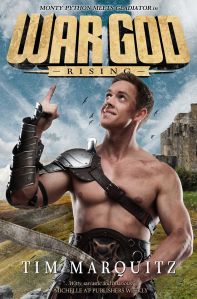 not disappoint. War God Rising is funny. We’re talking Mel Brooks funny. Quick asides, tongue-in-cheek, make you spit your soda out your nose funny. Marquitz writes with a quick easy style that makes you want to keep reading long past bedtime. His characters are clear and stand out as individuals that blend together into a symphony of humor. I’ve seen other reviews compare War God Rising to Monty Python. I’ll admit I’m not a huge fan of Monty Python. However, I’m a HUGE fan of Mel Brooks. Marquitz has the same timing and cheeky attitude you would find in any Brooks film.
 spellboundscribbler